 en
News
Content
A water crew pulls up to a 1970s subdivision to shut off a leaking service line. The curb box lid is easy enough to find in the lawn, but the sleeve below it has been driven roughly 150 mm under grade by a repaving crew, and the valve nut now sits about 40 mm off centre. A five-minute shutoff turns into a two-hour excavation while the customer's water keeps running.
Curb boxes rarely appear in a project specification until something like that happens. Yet they are the only part of a water service that a utility, a contractor, a landscaper and a homeowner all touch from the surface, and they carry no water themselves. Their entire job is to keep one buried valve reachable for 30 years or more.
The short answer: specify a curb box with three numbers before you choose a material — the installed depth range from finished grade to the curb stop, the load class of whatever passes above it, and the allowable offset between the operating nut and the sleeve centre. Get those three right and material selection becomes straightforward. Get them wrong and even a heavy-duty body will fail early.
A curb box, also called a valve box, is a vertical sleeve seated over the curb stop: the shutoff valve controlling a single water service at or near the property line. A typical assembly has a base that supports the sleeve around the service pipe, an adjustable or telescoping barrel, and a cover that finishes flush with paving or turf. The valve belongs to the service line; the box is simply the access route to it.
What a Curb Box Actually Does, Part by Part
Strip away the catalogue language and a curb box has four working parts. Each one carries a tolerance that decides whether the assembly still functions after ten winters.
- Base and pipe support. Holds the sleeve centred over the service line and resists vertical settlement. Uneven backfill under the base is the most common reason a barrel drifts out of plumb.
- Barrel or sleeve. Provides the straight vertical path for a valve key. The internal diameter has to clear the operating nut with enough clearance for the key socket to seat fully.
- Adjustment section. Telescoping or slip sections absorb grade changes, frost movement and repaving. A range of about 0.9 m (3 ft) of adjustment lets one product cover installations from roughly 1.2 m to 2.1 m deep.
- Cover and frame. Transfers surface loads and keeps soil, gravel and surface water out of the barrel. The cover's duty rating must match where it is installed, not where it is stored.
Depth and frost
The service pipe must sit below local frost depth while the box still reaches grade. In cold regions that means a 1.2–2.4 m total span, and the top section has to move when the ground does.
Load class
Lawn and footpath: A15 (1.5 t). Driveway or kerbside footway: B125 (12.5 t). Kerb line and carriageway margin: C250 (25 t). Full traffic lanes: D400 (40 t).
Alignment tolerance
Keeping the operating nut within roughly 25 mm of the sleeve centre is what makes a standard key usable years later. Beyond that, crews start digging.
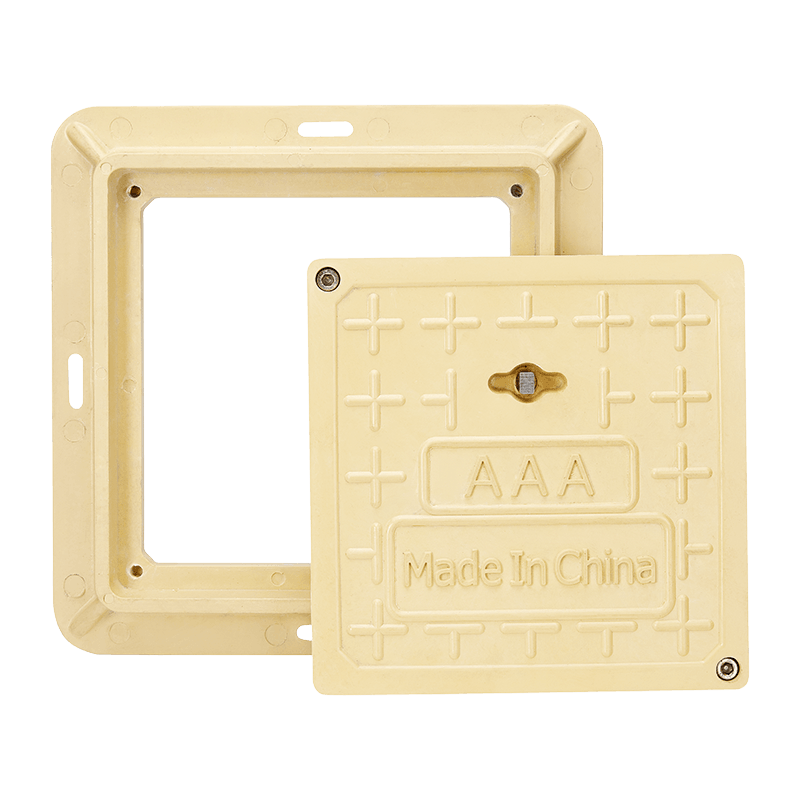
 Valve Box ManufacturersSMC composite meter boxes are made of SMC sheet molding compound, molded under high temperature and pressure in a single process. They are specifically designed to pro...View Product →
Cast Iron, Plastic or Composite: How the Options Compare
Material gets blamed for most curb box failures, but it is usually the least important variable. What matters is how each body behaves under ground movement, moisture and repeated key torque.
Typical mass
Heavy; lifting gear needed beyond shallow sets
Light; one-person handling
Light to moderate, roughly half of cast iron for equal duty
Corrosion behaviour
Graphitic corrosion in aggressive soils; coating quality decides life
Chemically inert but degrades under UV above grade
Non-metallic; no galvanic or graphitic corrosion
Response to ground movement
Rigid; cracks or shears at joints under frost heave
Flexible, but can buckle under vertical load
Rigid body with elastic recovery; tolerates moderate movement
Drinking water compliance
Body may avoid wetted surfaces, but fittings often do not
Lead-free by formulation
Lead-free grades available with supporting documentation
Expected service life
30–50 years where coatings hold
20–30 years
30–50 years with a UV-stable grade
Relative installed cost
Baseline
Lower upfront, higher replacement frequency
Higher upfront, lower lifecycle cost where corrosion or weight is a real constraint
Comparison is indicative for 25–50 mm water service shutoffs; local standards, frost depth and individual utility specifications override these general ranges.
Two practical notes sit behind that table. First, the cover rating matters more than the body material — a composite body with an undersized lid fails long before a cast iron body with the correct one. If cover shape and load class are still open questions, this comparison of square and round covers and how load class drives the choice is worth reading before you freeze the specification. Second, wetted-surface lead rules apply to anything that contacts drinking water, and the 0.25 percent weighted average lead limit under NSF/ANSI 372 is enforced in several states regardless of what the box body is made from.
Where Curb Box Failures Actually Come From
Field failures cluster tightly around a handful of causes. The chart below shows an indicative split drawn from common municipal work-order categories; treat it as a planning guide rather than a survey result.
32%
Nut misalignment
24%
Cover missing or broken
19%
Sleeve displaced by paving or frost
15%
Silt and debris fill
10%
Seized rod or corrosion
The pattern is consistent: three of the four leading causes are installation and grade-control problems, not material degradation. That is why widening the adjustment range and tightening the alignment tolerance usually returns more than upgrading the alloy.
Where Curb Boxes Get Specified
Demand follows water infrastructure spending rather than new construction alone. Replacement programmes dominate, and each segment tends to standardise on a different depth and cover class.
- Water main and service renewal, 40%. Utility-owned boxes and stops, replaced in cohorts with standardised depths.
- New residential development, 27%. Bulk installation with A15 or B125 covers and uniform depth across a plat.
- Commercial and institutional, 20%. Airports, hospitals and campuses where inspection records and access times are contractual.
- Industrial and utility retrofit, 13%. Process water, fire service and non-standard alignments that rarely fit a catalogue depth.
A Five-Step Selection and Installation Sequence
Working through these five steps in order keeps the specification honest and gives the installer a tolerance to hold on site.
- Fix the depth envelope. Measure from finished grade to the top of the curb stop, then check local frost depth. A box offering about 0.9 m of vertical adjustment covers most of that range without a second part number.
- Set the load class from the surface, not the address. Lawns and footpaths take A15, driveways and kerbside footways B125, kerb lines C250, and carriageways D400.
- Choose the body material last. Cast iron where abrasion and heavy key torque dominate, PVC or PE where the grade is stable and budget leads, and SMC composite where corrosion, handling weight or non-conductive, lead-free requirements decide the outcome.
- Verify wetted-surface compliance. Request NSF/ANSI 61 and NSF/ANSI 372 documentation for any component touching drinking water, and keep the certificates with the submittal package.
- Lock alignment and records. Hold the operating nut within about 25 mm of the sleeve centre, then record depth, offset, cover class and installation date in the asset register before backfill is signed off.
Manhole Chamber ManufacturersThe JF-C composite manhole is specifically designed for personnel access and maintenance. Utilizing a high-strength SMC molding process, it features a smooth, high-str...View Product → Water Meter Box ManufacturersComposite water meter boxes are specifically designed for the protection of outdoor water meters. Made from high-strength composite materials through molding, they pos...View Product →Maintenance, Records and Compliance
A curb box that is installed correctly still degrades through neglect. These checks are cheap and they prevent the majority of emergency excavations.
- Flush cover. Keep the lid within roughly ±3 mm of surrounding grade. A proud cover is a trip hazard; a low one gathers grit and hides the nut.
- Clear zone. Maintain about 150 mm of clear ground around the lid, free of paving, root growth and landscape fabric.
- Annual exercise. Operate the curb stop through its full range once a year where records allow. A seized valve is a failure even when the box itself is perfect.
- Documentation. Load class markings, drinking water component certification and right-of-way excavation permits belong in the same file as the installation photographs.
In freezing climates, add one inspection after the first hard frost and another after spring thaw, when frost heave has finished moving the ground. Both visits take minutes from the surface and both prevent a mid-winter dig.
Curb boxes are small and inexpensive relative to the mains they serve, which is exactly why they get treated as an afterthought in procurement. The specification that prevents most callouts is not exotic: a wide depth adjustment range, a cover rated for the traffic above it, and an alignment a standard key can still find after a decade of ground movement.
For projects that combine buried access structures with surface covers, buying from one supplier under one quality system makes those tolerances easier to hold across the whole package, from composite chambers, covers and valve boxes through to the meter boxes sitting beside them on the same service run.