 en
en News
Content
- 1 Are Square Manhole Covers Actually Safe for Vehicle Traffic?
- 2 Core Design Characteristics of Square Manhole Covers
- 3 Square vs. Round vs. Rectangular: Performance Comparison
- 4 Cost Per Square Meter of Access Area: Where Square Covers Win
- 5 Where Square Manhole Covers Dominate the Spec Sheet
- 6 Selection and Specification Workflow
- 7 Maintenance and Compliance Notes
- 8 Frequently Asked Questions
- 9 Summary
Engineers specifying access covers for electrical vaults, telecom pull boxes, and utility chambers often default to round without checking whether the opening geometry actually calls for it. Square manhole covers exist for a reason — they maximize usable access area within a given footprint, and for non-traffic or bolted-down installations, that trade-off usually wins on both cost and functionality.
Core Finding
For utility vaults, electrical chambers, and telecom pull boxes, square manhole covers deliver up to 27% more clear access area than a round cover occupying the same footprint, while material cost per unit typically runs 10–15% lower due to simpler mold and casting geometry — provided the installation is correctly restricted to non-traffic or bolted-down applications.
Are Square Manhole Covers Actually Safe for Vehicle Traffic?
This is the question that trips up most first-time specifiers. Unlike a round lid, a square cover can physically fall through its own opening if tilted onto the diagonal — the diagonal measurement of a square exceeds its side length, while a circle's diameter is constant in every direction. That single geometric fact is why square covers are restricted to non-traffic zones or require positive locking hardware (bolted or hinged) before they're approved for any location where displacement is possible. Where an engineer specs a bolted-down square cover for a vault, this risk is designed out entirely.
Core Design Characteristics of Square Manhole Covers
Maximum Access Area
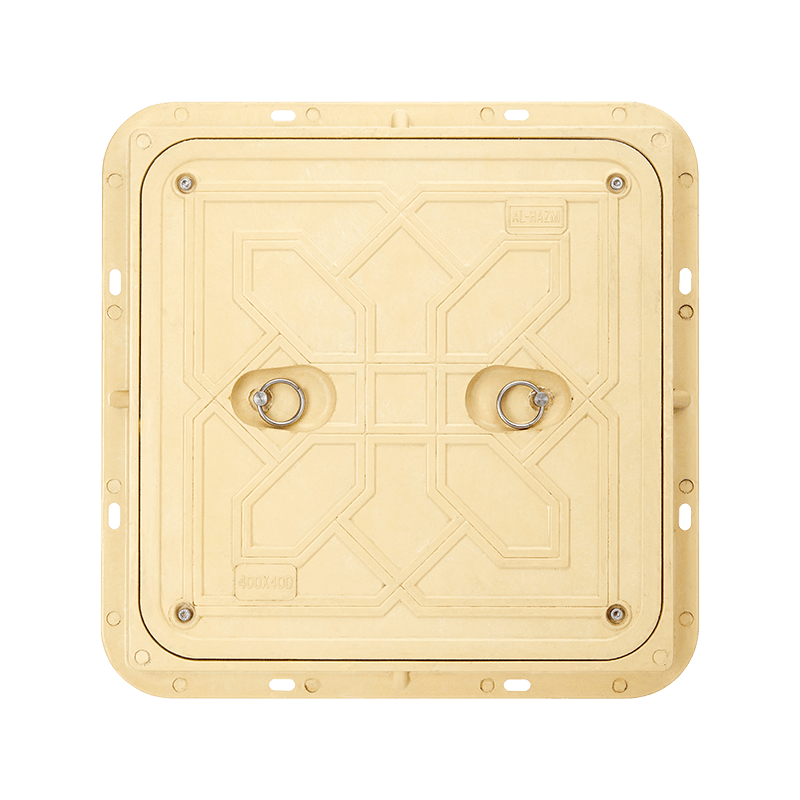
Corner-to-corner coverage fills the full footprint, giving technicians more room to lower equipment or ladders into a vault than a round cover of equal width would allow.
Grid-Aligned Installation
Straight edges seat cleanly against modular pavers, sidewalk joints, and grid-paved surfaces without the awkward radial gap a round frame leaves behind.
Lower Manufacturing Cost
Simpler mold geometry and less material waste during casting or compression molding translate to a lower per-unit price than an equivalent-strength round cover.
Positive Locking Hardware
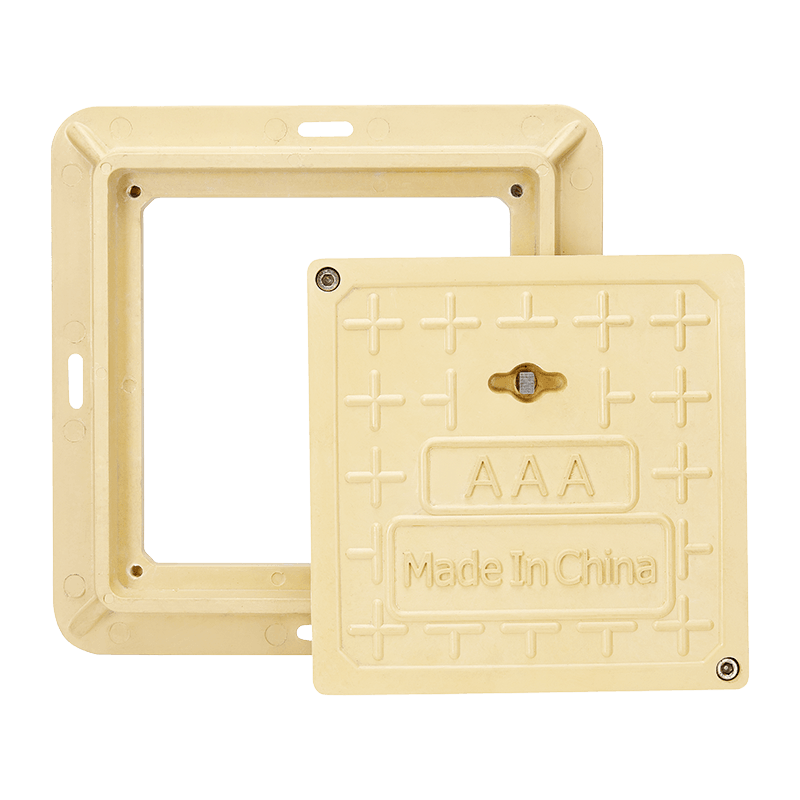
Bolted or hinged-lock designs anchor the cover to the frame, eliminating the fall-through risk inherent to a loose-fit square lid.
Corner Stress Reinforcement
Higher-grade square covers incorporate reinforced corner ribbing, since load concentrates at the corners rather than distributing evenly as it does on a round lid.
Multi-Panel Configurations
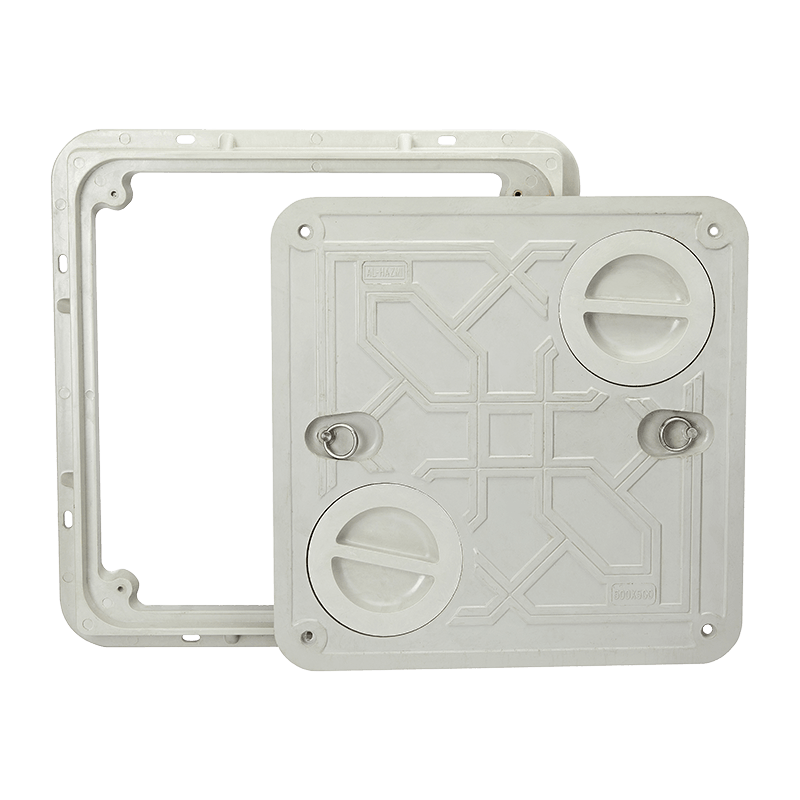
Large vault openings often use multi-panel square or rectangular cover sets, allowing one crew member to lift individual sections instead of a single oversized lid.
Square vs. Round vs. Rectangular: Performance Comparison
The shape decision comes down to matching the cover's mechanical behavior to the installation's actual risk profile:
Table 1: Comparative performance characteristics across common manhole cover geometries, based on standard EN124 classification practice.
Cost Per Square Meter of Access Area: Where Square Covers Win
The metric procurement teams often overlook is cost per unit of usable access area, not just cost per cover. Modeled across a standard 600mm nominal opening at equivalent load class:
$142/m²
Square (Ductile Iron)
$178/m²
Round (Ductile Iron)
$165/m²
Square (BMC Composite)
$204/m²
Round (BMC Composite)
Figure 1: Estimated cost per square meter of clear access area by cover geometry and material, at equivalent load classification.
On large vault installations requiring multiple covers, this per-area gap compounds quickly — a telecom vault needing four round covers to match the access area of three square units adds both material cost and installation labor.
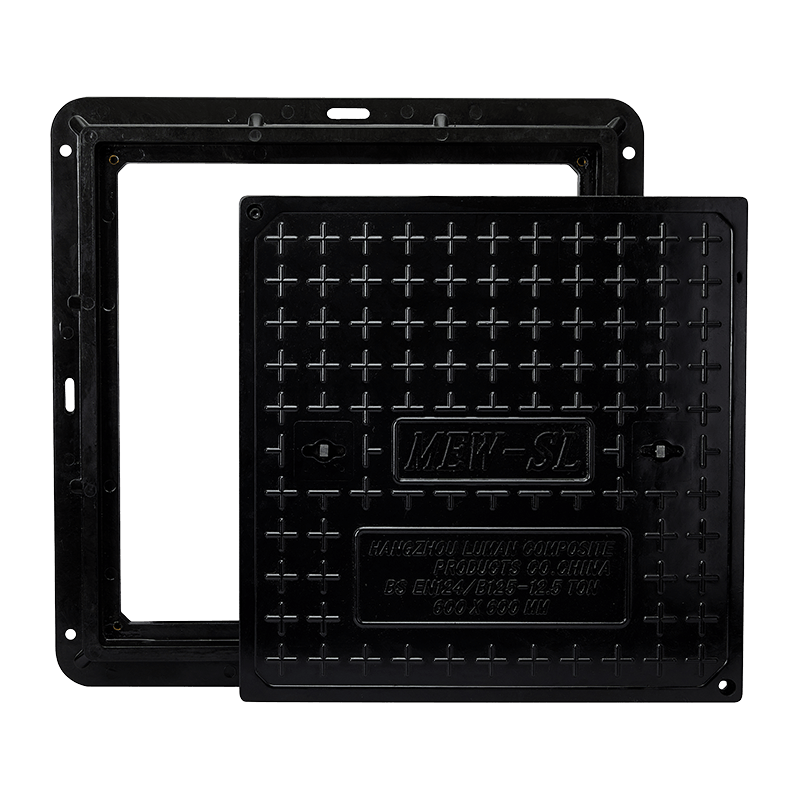
Where Square Manhole Covers Dominate the Spec Sheet
Adoption clusters heavily around installations where non-traffic access and equipment clearance matter more than vehicle loading:
Electrical & power vaults — 35%
Telecom & data pull boxes — 27%
Sidewalks & pedestrian plazas — 18%
Commercial building services — 13%
Landscaped & park settings — 7%
Figure 2: Estimated distribution of square manhole cover installations by end-use application, based on typical utility procurement patterns.
Selection and Specification Workflow
1
Confirm Traffic Exposure
Verify the location is genuinely non-traffic or restricted-access — square covers without positive locking should never be specified where vehicle traffic is possible.
2
Measure Clear Opening, Not Overall Size
Specify by the internal clear opening dimension of the vault, since the overall frame footprint varies between manufacturers even at the same nominal size.
3
Select Locking Configuration
Choose lay-in for infrequent access or hinged-locking for daily-use vaults where the cover should remain attached to the frame during opening.
4
Decide Single-Panel vs. Multi-Panel
For large vault openings above roughly 900mm, evaluate whether a multi-panel configuration reduces the per-lift weight for field crews.
5
Bed the Frame Level with Grade
Install on a properly cured mortar or concrete bed, taking extra care with corner support since square frames concentrate load differently than round frames.
6
Document Orientation for Replacement
Record installation orientation in the asset log, since unlike round covers, square lids must be replaced in correct alignment to seat properly.
Maintenance and Compliance Notes
- Inspect corner reinforcement points during routine checks — corners bear disproportionate stress and are the first area to show fatigue cracking on lower-grade castings.
- Verify locking bolts remain torqued to spec; a loosened bolt on a square cover carries higher consequence than on a round one due to the fall-through geometry.
- Confirm the cover's load class matches current site use — a vault originally speced for pedestrian access that now sees occasional service vehicles requires reclassification, not just a heavier-looking replacement lid.
- Check gasket or seal condition on vaults exposed to surface water, since square frame corners are historically harder to seal fully than a continuous round perimeter.
- Where local code or utility standard restricts square covers to non-traffic zones, keep documentation of that classification on file for inspection and liability records.
Frequently Asked Questions
Can square manhole covers be used on roadways?
Only with positive locking hardware and an appropriate load rating. Without bolted or hinged-lock attachment, square covers are generally restricted to non-traffic or pedestrian-only zones due to their diagonal fall-through risk.
Why do square covers cost less than round covers of the same nominal size?
Square molds are simpler to produce and generate less material waste during casting or compression molding, and the flat-edge geometry requires less machining to achieve a precise frame seat than a round profile does.
What load rating is standard for a square utility vault cover?
Most electrical and telecom vaults specify B125, suitable for pedestrian and light incidental vehicle contact. Locations with occasional service vehicle access typically step up to C250 or D400 with locking hardware.
Do square covers require a specific orientation when reinstalled?
Yes. Unlike round covers, which seat correctly at any rotation, square lids must align with the frame's specific orientation to seat flush and engage locking points properly.
What materials are square manhole covers available in?
Ductile iron, cast iron, BMC/composite, and fabricated steel are all available in square configurations. Composite is common where corrosion resistance and lighter weight matter, while ductile iron handles higher load classes.
How much bigger should the vault opening be than the equipment being installed?
This depends on the specific equipment and access requirements, so it's best confirmed with the vault design engineer — but square covers' higher access-area-to-footprint ratio generally gives more working clearance margin than a round cover at the same nominal width.
Can multi-panel square covers replace a single large lid?
Yes, and it's common practice for large vault openings. Splitting a large opening into two or three bolted panels reduces individual lift weight, letting a single technician manage routine access without lifting equipment.
Are square covers harder to seal against water than round covers?
Corners can be more challenging to seal fully compared to a continuous round perimeter, which is why quality square covers use a continuous gasket profile specifically engineered to maintain compression evenly through the corner radius.
Summary
The choice isn't square versus round in the abstract — it's matching cover geometry to actual site conditions. For vaults, sidewalks, and non-traffic utility access where maximum opening area and lower cost per square meter matter more than omnidirectional load distribution, square manhole covers with proper locking hardware remain the engineering-sound choice.
Hangzhou Jufeng Urban Support Equipment Co., Ltd. manufactures ductile iron and BMC composite square manhole covers with bolted or hinged-locking configurations for utility vaults, electrical chambers, and telecom access points. Engineers and procurement teams are welcome to request load test data and clear-opening drawings for project-specific specification.